Abuses during international animal transports |
Animal suffering during transport
 GAIA (Belgium) made the basis of this version of the script of the CIWF-film 'Some lie dying'. GAIA (Belgium) made the basis of this version of the script of the CIWF-film 'Some lie dying'.
International transports of animals
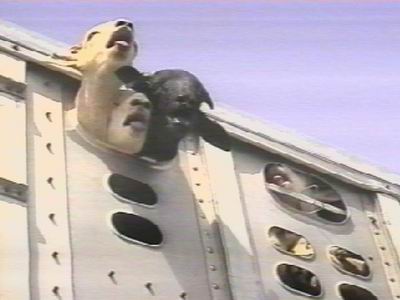
Each year millions of sheep,
pigs and cattle are transported across Europe, often
on extremely long journeys.
The 1995 EU Transport Directive was hailed
by EU governments as a measure which would help end
the suffering involved in long distance transport. To
find out whether the Directive is really working animal
welfare investigators have been busy trailing
the livestock trucks.
|
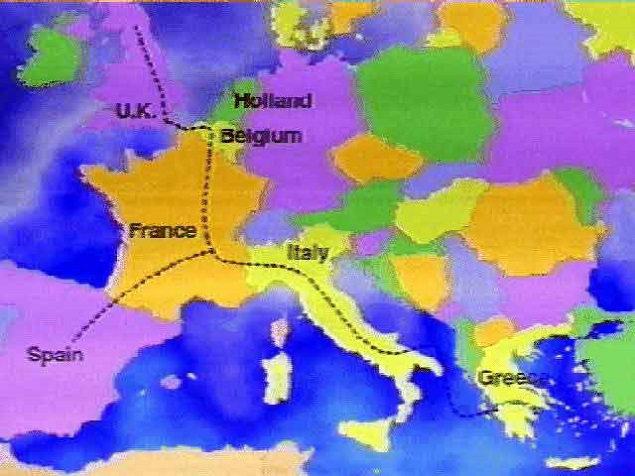
| Many of the one million lambs and sheep
exported each year from Britain are sent to staging
points in Belgium and Holland. From there, after
a break of around 24 hours, they are re-exported
to abattoirs in Italy, Greece and Spain.
Compassion In World Farming (CIWF) trailed these sheep all the way from
Belgium to southern Italy on a journey which covered over 2000 kilometres and lasted for 30 hours.
When the journey from the UK to Belgium is added, the
animals probably travelled for well over 40 hours. |
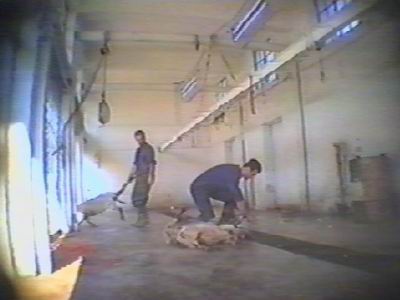
| On an earlier occasion we
managed to film inside the Italian abattoir in which
the sheep we trailed were slaughtered.
There we found animals being dragged
along by their back legs to the stunning
point. Huge numbers of sheep from Britain,
France and Spain regularly pour into the Italian
port of Bari from where they are shipped for slaughter
in Greece. For the British animals these journeys to
Greece can last anything from 65 to over 100 hours.
On one occasion in Bari investigators came
across two truckloads of UK and French sheep which
had been left waiting for 48 hours for a ferry
to Greece. Throughout this time the animals were
kept on the trucks in blistering heat without
any water.
After two days they were in a desperate
state - gasping
and panting for air. Eventually,
after repeated pleas from our investigators, the Italian
authorities decided that the sheep should be unloaded.
For many this came too late. As they helped in the unloading,
our investigators found that a large number were dead
or dying.
During the next two more days more
animals died.
The official Italian veterinary report shows
that altogether 115 UK lambs and 45 French sheep
perished in this disaster. The whole of Europe
is criss-crossed by these cruel journeys. |
| Over a million pigs
a year are exported from Holland to Italy and
Spain on journeys that can last for 40 or 50 hours or more. Thousands of cattle are exported
every year from Ireland and Germany to Italy and
Spain and from France to Greece.
Moreover, young calves are shipped from
Ireland to northern France and then on by road to Dutch
veal farms. Here they are reared
in small barren pens.
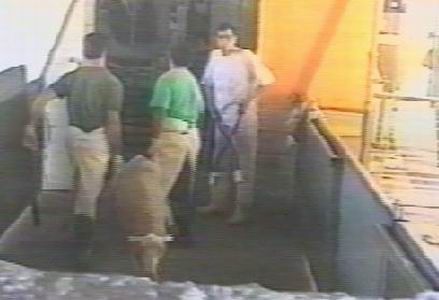
Animals are often roughly treated during loading and unloading. Here in France cattle
are being hit to move.
The treatment of this calf is completly unacceptable.
Each
year, more than a hundred thousand horses are exported
from eastern Europe for slaughter in the EU. Most come
from Poland, Lithuania and Romania. For the majority
the destination is Italy.
Investigators from the German organisation, Animals' Angels, trailed these horses from Lithuania.
They are driven through Poland to the staging point
of Zebrzydowice near the border between Poland and the
Czech Republic.
They are then trucked through the Czech Republic, Slovakia
and Hungary. By the time they get to Hungary the horses
are often worn out, injured and stressed. And yet they
are still only halfway through their long journey to
Italian slaughterhouses. This
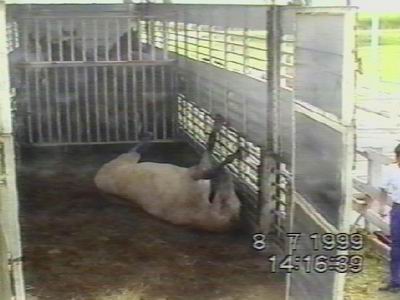
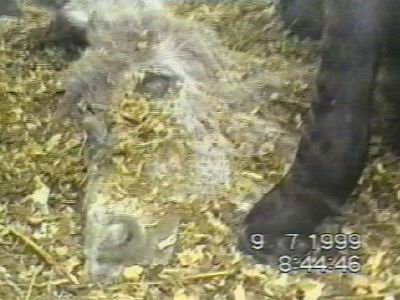
horse has got its hoof caught
in the truck's ventilation slats. Eventually
it is put down. After that the worker sets about
removing its hoof. Finally, the animal is hauled
off the truck, another victim of the cruel horse
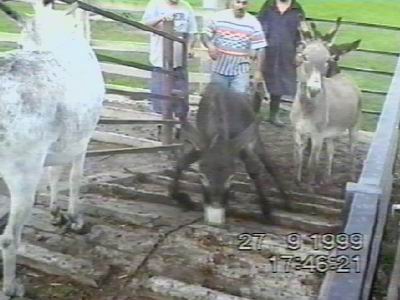
trade. Donkeys, too, are sent from
Romania through Hungary and on to Italian abattoirs. Some
die halfway through the journey.
These donkeys have great
difficulty in climbing the steep ramp. |
| Our film now returns to the journey of the Lithuanian horses.
From Hungary they are driven through Slovenia. At last, after travelling for 46 hours, they arrive
in Italy.
Here they are unloaded. No veterinary care, however,
is available. It is a Sunday and no vets are present.
The next day the journey starts again and the animals
begin to cross Italy.
The horses are now entering the fourth
night of their journey. Eventually, at 10:30 in the
evening, they reach the port of Piombino on the west
coast of Italy. Here they are loaded on to a ferry
which will take them to Sardinia. They arrive at the
port of Olbia in Northern Sardinia at 7.00 the next
morning. From there the animals are trucked across
the island to Cagliari in the south. Here they are
slaughtered.
In all the journey from Lithuania
to Sardinia was 2500 kilometres in length and lasted
95 hours. |
| Earlier we saw the suffering involved for British lambs exported to Greece. A terrible
fate awaits those who survive the long journeys: slaughter
in a Greek abattoir.
We have managed to film in three Greek
sheep abattoirs. Two made no attempt at
all to stun the animals into unconsciousness before
slaughter. They were simply dragged off
the truck and into the abattoir. There their throats were cut while they were fully
conscious and they were left to bleed
to death.
The third abattoir did stun
the sheep, but so ineply that some
regained consciousness from the stun before
throat-cutting.
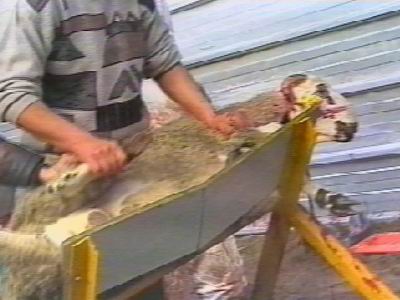
Each year thousands of British sheep are
exported for outdoor ritual slaughter at the annual
Eid-el-Kabir festival in France. The animal in the background
had its throat cut quite some time ago. Yet it is still
alive and clearly in distress. The
sheep are placed on tresles. Then they are held
down and their throats are cut while they are fully
conscious. Outdoor ritual slaughter is illegal under
EU law. |
| Each year hundreds of thousands
of cattle are exported from the EU - mainly from Ireland,
Germany and France - to the Middle East and North Africa.
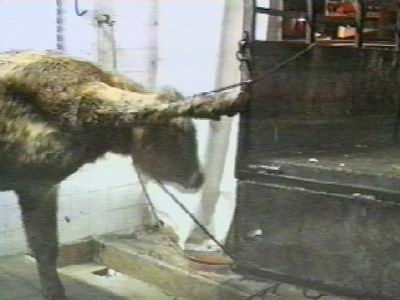
At this Lebanese abattoir we find an Irish
bull. The truck isn't equipped with a
ramp to help unloading. Instead the animal simply
tumbles out. His front leg had been tied
to the side of the truck. This is done
deliberately to position him by a drain. When
his throat is cut, the blood will flow directly
into the drain, rather than over the floor.
Huge sums are paid out in subsidies to encourage the
export of EU cattle to non-EU countries. The
traders are being rewarded for keeping animals away
from the EU's beef mountain.
Usually in the Middle East animals are not stunned
before slaughter. A German
animal's throat is cut while it is fully conscious. The sound
you can hear is the animal trying to breathe.
The European Coalition for Farm Animals
urges the EU to adopt a major change of policy
whereby the long distance transport of live animals
is abandoned and replaced by a trade in meat. |
|
In the meantime in Australia:
Australia is the biggest live animal exporting
country in the world. Despite those economic considerations
- this industry brings in around $900 million per annum,
it comes at a far greater cost and Australians are saying
this barbaric trade is not worth it.
Live Export Shame has been developed for
the purpose of informing the general public within Australia
and overseas on all the issues surrounding the live export
industry and the involvement of the Australian Government.
See also the pictures inside the stinking ship at Cape Town harbour carrying 19,000 cattle to the Middle East. |
|
|
|
|
| |