Worldwide all cattle is fed 735 billion kilo grain every year.
Conveyed in a goods train the transport would require 12,3 million wagons.
That train could easily span the equator 6 times.
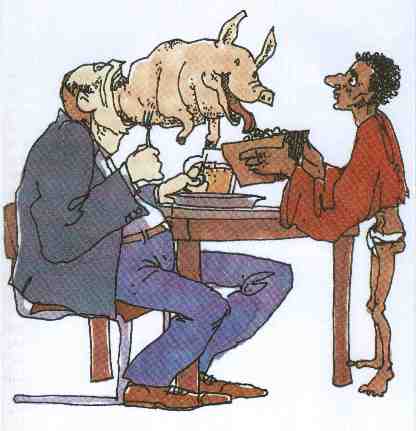
Most of the western countries use, besides their own farming ground, large grounds of developing countries for the production of their cattle feed.
The use of foreign grounds can be up to six times higher than that of private grounds.
Countries like Thailand (cassav), Malaysia, Brazil (soy) and Argentina largely contribute to the production of our cattle feed and almost a third is produced by third world countries.
75% of the raw materials for poultry-food and food for swine come from abroad.
About a third of which comes from the third world countries.
For example, in order to feed the Dutch people there is, at home and abroad, 1,20 hectare of agricultural land in production, while there is in fact per citizen of the world only 0,2 hectare of agricultural land available (1 hectare equals to 10.000 m²).
Every individual in the world uses an amount of space of planet earth.
How much, depends upon one's consumption.
Meat production leads to environmental pollution
In the west, the biggest sources of acid
precipitation, affecting forest and heather,
are stock farming and traffic. Since fertilizer
is one of the great contributors to this,
the environment would profit largely from
a diminished production.
Meat production costs lives
In the west, people consume much more meat these
days than they used to do in the old days. Vegans,
who totally abstain from meat consumption and
use of animals, save the lives of approximately
6 bovines, 45 pigs en a few hundred chickens (these
numbers apply to the Netherlands).
By means of the bio-industry all this
meat consumption brings about a lot of animal
distress. Thus, lessening the worldwide
meat consumption obviously reduces the amount
of animal distress.
Meat production is a waste of energy
During the transformation from plant into
animal protein a lot of nutritious matter
is wasted. 4 Kilo of vegetable protein (cattle
feed) on average yields only 1 kilogram
of animal protein.
On average, the production of meat costs
up to 14,7 times more energy than that of
vegetable food. One kilo veal compares to
100 kilo potatoes, as for the amount of
energy. A normal pasture field produces
approximately 330 kilo meat. The same field
yields 40.000 kilo potatoes. Moreover a
kilo meat requires 111.250 liter water.
It takes a lot less water to feed a strict
vegetarian during a whole year than to feed
a meat eater during a single month. A country
like Holland uses so much water for the
production of bovine meat in a year that
the same amount of drinking water could
supply almost a third of the world population.
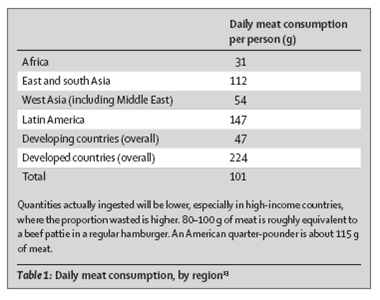
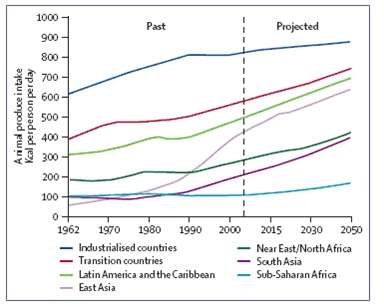
From the factsheet "Meat", the daily meat consumption in 2007 and projected in 2050.

 Worldwide all cattle is fed 735 billion kilo grain every year.