History and problems of intensive livestock farming |
||||||||||||||||
|
This is an extensive article. It is structured as a route: eight stops along the main line, with side tracks along the way for those who want to go deeper. How would you like to read?
The green line is the main line of the article. The yellow branches are side tracks: background you can skip without losing the thread. Click a stop or side track to go straight there; use the back button of your browser (previous page) to return here to the map. Stop 1 of 8 · From mixed farm to factory farming From mixed farm to factory farmingIn the past, agriculture in the Netherlands was carried out by mixed farms. These were small farms with a few cows, a couple of pigs for meat and horses for draught. Arable farming was aimed at producing feed for the farm's own animals. The rest of the produce was sold at the local market or used for the farmer's own consumption. It was quite hard for these small farms to keep their heads above water, especially on the poor sandy soils. After the Second World War Dutch government policy aimed at restoring the economy and industrial production. To increase people's purchasing power, the price of food was kept low. But farmers did need a good income, so agricultural production had to rise sharply. This was achieved through mechanisation: the same work could be done with far less labour. Yields were raised with artificial fertiliser, pesticides and concentrated feed. Dutch agriculture thus became dependent on other countries: on imported raw materials for animal feed and on the export of its products. The agricultural policy of the European Union gained more and more influence on developments at home. The result: the Netherlands is one of the most densely stocked countries in the world. In 2025 the country had almost 10 million pigs, more than 3.6 million cattle, almost 600,000 goats and more than 80 million chickens. Because broilers and pigs are delivered several times a year, more than half a billion animals are slaughtered every year, 518 million of them chickens. The Netherlands produces far more than it eats: almost three times as much pork and one and a half times as much chicken. Most of it goes abroad. In 1950 there were more than 300,000 farms. In 2025 there were 49,077 left. Mechanisation, automation and robots have made the work lighter. The differences between large and small farms keep growing. Stop 2 of 8 · What is factory farming? What is factory farming?Factory farming or intensive livestock farming means keeping animals in an industrial way, with the aim of making animals produce as quickly, efficiently, on as large a scale and as much as possible. Care and welfare are geared to maximising production. Anything that would make an animal's life more pleasant but lower productivity is left out. Feed is bought from the cheapest supplier. Manure is disposed of in the cheapest way. Industrial farming goes hand in hand with loneliness and boredom for the animal. An animal is kept in production (read: alive) no longer than is economically justified; after that it is slaughtered. While a cow can easily live to 20, she is often slaughtered after only 5 or 6 years. A laying hen goes to slaughter after little more than a year, long before the end of her natural life. Free-range farming is not by definition much better for the animal or the environment: it is a compromise between economics and animal welfare. When the animal is truly able to show natural behaviour and the mineral balance on the farm is ecologically sound, we speak of organic meat. Side track A · Different kinds of farmers (± 1 min) Different kinds of farmersThe collective name "farmers" covers arable farmers, farmers with a mixed farm of crops and livestock and livestock farmers without land of their own. Pig and poultry farmers often have no farmland on which they can spread their manure. This group of livestock farmers, which did not exist in the past, is particularly controversial. Their way of farming disturbs the national and international mineral balance: they keep too many animals in too little space, produce mainly for export and pollute the environment at home. They often do not live on their farm, just as the owner of a factory does not live on the industrial estate. Automation has made their presence unnecessary and because of the ugliness of the buildings, the smell and the noise it is more attractive to live elsewhere. You could call these farmers subcontractors of the meat processing industry. The same applies to livestock farmers with a mixed farm who keep more animals than their own feed crops and manure capacity can support. Together these two groups make up factory farming. They are more entrepreneurs than farmers, attracted by the chance to earn a lot of money and limited only by the government and the banks. Stop 3 of 8 · Economy and subsidies Economy and subsidiesCurrent farming methods cause problems whose costs are not included in the price of our food. They are passed on to all citizens through taxes: problems for the environment, health, animal welfare and the farmers themselves. The European Union steers the supply and prices of farm products through its Common Agricultural Policy (CAP). For a long time this was done with guaranteed prices, levies and export subsidies. As a result production grew sharply and the well-known butter mountains, milk lakes and grain surpluses arose. To get rid of these surpluses outside Europe, export subsidies were paid, so that farmers in other parts of the world received only a meagre price for their products. Milk quotas, which limited milk production, were abolished in 2015. After that the dairy herd grew again. About a third of the EU budget still goes to agriculture. In 2023-2027 Dutch farmers receive about 790 million euros a year from Brussels, about 1.1 billion euros a year including the national contribution. At the same time the contribution of agriculture to the Dutch economy is modest: primary agriculture and horticulture account for about 1.4 percent of gross domestic product, the whole intensive livestock complex for 0.9 percent. Against this stands at least 9 billion euros of damage a year from intensive livestock farming alone. Surprisingly, on balance Dutch agriculture costs society money: neither arable farming and horticulture nor intensive livestock farming contribute to the Dutch economy. The point is not that food should be cheaper. Prices should be fairer and improper subsidies should stop. Another consequence of this policy is that countries in the South, such as Brazil, grow more and more crops for animal feed, especially soya. This earns those countries money, but often at the expense of rainforest and of food for their own people. Side track B · Where does the milk price go? (± ½ min) Where does the milk price go?In 2001 the Dutch newspaper de Volkskrant calculated how the price of 10 litres of milk was built up along the chain. The most striking point: the shop sold milk below its purchase price. The farmer's margin was extremely small. Simply raising the shop price would not help. Competition from abroad also made it hard to increase the farmer's margin. The free market keeps the farmer captive and with him his animals.
2.20 guilders = 1 euro. Stop 4 of 8 · Social consequences Social consequencesBecause of the changed farm economy after the war, a sufficient income could only be earned on a modernised, large-scale farm. As a result the number of farmers has fallen sharply. Fewer large farms fit on the same area of land and farms that could not keep up with the growth were driven out of business. Land prices have risen steeply. The remaining farmers have to work hard to stay ahead of the competition. This leads to stress. Working with pesticides can cause health problems. See also the column Brabant Blues, an impression of the background and motives of pig farmers in the province of Brabant. Finally, the farmer is so entangled in a web of loans, subsidies, rules and agreements with buyers that there is hardly any independence left. Investments of millions of euros are no exception in intensive livestock farming. Someone who is that deep in debt finds it hard to change course. Stop 5 of 8 · Manure, nitrogen and climate Manure, nitrogen and climate
On a world scale these steps increasingly take place in different places. Soya is grown in South America and goes to Europe as animal feed. Here the animals turn it into manure, which does not return to the soil the nutrients came from. The result is exhausted soil there and a surplus of manure here. The best-known environmental problem of Dutch livestock farming is the manure surplus. In 2024 the animals in the Netherlands produced 74 billion kilos of manure, containing 449 million kilos of nitrogen and 147 million kilos of phosphate. See the numbers of animals in the Netherlands. Far more manure is produced than the soil needs. Because farmers cannot get rid of it, much of it is spread on the land anyway. Problems arise especially where livestock farming is concentrated, such as in Brabant. For fertilising farmland there are four possibilities:
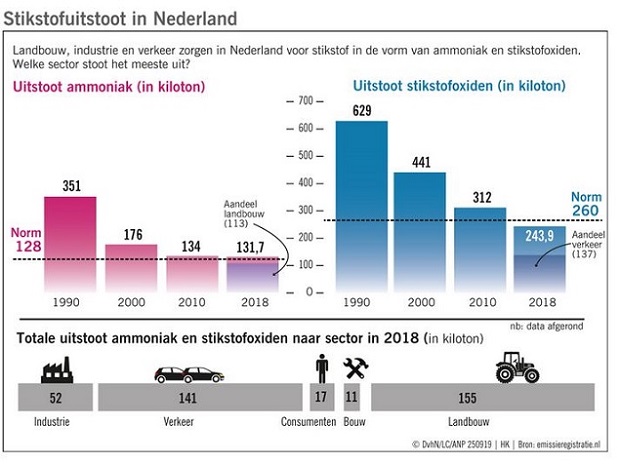
On livestock farmers' land situation 3 or 4 is common. That is why you see so much maize: it is animal feed and one of the few crops that can still tolerate over-fertilisation. When manure is spread over bare land in early spring, local residents often suffer from irritated airways. Manure releases ammonia, a nitrogen compound. Agriculture is the largest source of nitrogen emissions in the Netherlands. In May 2019 the Council of State, the highest administrative court, ruled that the government could no longer base permits for nitrogen emissions on promises for the future (the Programmatic Approach to Nitrogen). Since then the nitrogen crisis has been high on the political agenda. Livestock farming also contributes to global warming, mainly through methane from cows and deforestation for animal feed. Side track C · Ammonia and plants (± ½ min) Ammonia and plantsExposure of plants to ammonia can have both negative and positive effects. High concentrations are toxic and lead to discoloured and dying leaves. Such concentrations are rare and usually occur in accidents during the production or transport of ammonia. At lower concentrations ammonia first acts as a fertiliser: the plant grows faster. Yet these positive effects usually go together with serious changes that reduce the plant's vitality: a disturbed nutrient balance, earlier leaf or needle fall, poorer budding and fewer mycorrhizae (the partnership between fungi and plant roots that enables the uptake of nutrients and water). As a result plants become more sensitive to drought, frost, insect plagues and disease. Fast growers such as nettles and grass thus crowd out plants of poor soils, such as heather. Stop 6 of 8 · Health and animal diseases Health and animal diseasesManure contains dead bacteria with endotoxins. These can cause flu-like symptoms in people who work with manure or animal feed. Mycotoxins can also cause complaints such as chronic colds, shortness of breath, asthma, a blocked nose, irritated eyes and headaches. The heavy use of antibiotics in livestock farming contributes to resistant bacteria. Meat can contain dioxin and pesticide residues. Where many animals live close together, diseases spread fast. Since the mid-1990s Dutch livestock farming has been hit again and again by contagious animal diseases. Tens of millions of animals have been killed prematurely, most of them without being ill themselves. Some of these diseases are also dangerous to humans. Side track D · A timeline of outbreaks (± 1 min) A timeline of outbreaks
Stop 7 of 8 · Why so many live animals? Why are so many live animals transported?The transport of live animals spreads diseases such as foot-and-mouth disease across Europe. Yet huge numbers of animals are transported alive every year. In 2024 the Netherlands exported 366 million poultry, 9.5 million pigs and half a million cattle alive. According to Dutch agricultural economists, this transport has economic reasons, in which history, consumer behaviour and European rules play an important role. Around 1960 the Dutch discovered how to make cheap calf feed from whey and skimmed milk. From then on dairy farmers could also make money from their bull calves, which until then had been a superfluous by-product. Special veal farms were set up. When milk quotas were introduced in 1984 and fewer calves were born, the veal farms started to import calves. Many calves still come from abroad to Dutch veal farms. Piglets and fattening pigs mainly go to Germany. There they are fattened or slaughtered and sold as German pork. German consumers prefer German pork and a pig slaughtered in Germany counts as German. Side track E · Parma ham (± ½ min) Parma hamAn earlier version of this article stated that Parma ham could come from Dutch pigs. The Consorzio del Prosciutto di Parma let us know: "By law Parma ham may and can only be made from Italian pigs. After birth the Italian animals receive a tattoo that remains traceable on the ham right up to the shop. This rules out the use of imported meat or animals for making Parma ham. Many meat products are made from Dutch meat in Spain and Italy, but not Parma ham". Stop 8 of 8 · Solutions and scaling up Solutions and scaling upThe costs of the problems are not included in the price, so food from this kind of farming is cheap. Yet more and more consumers are critical, especially of meat. This is due to animal-unfriendly production, the use of antibiotics and the outbreaks of animal diseases. This has created demand for products that are better for the environment and for animals. Conventional farming is responding to this. But not everything that is called "green" is also animal-friendly. Nor the other way round: because animals can go outside, the emission of nutrients is greater. For environmental reasons a smaller livestock population is therefore a good thing even when farms switch to organic farming. Low-emission sheds (formerly Green Label)To reduce the environmental burden, low-emission sheds are being built, formerly called Green Label sheds. Less ammonia, smell and noise escapes. The manure, of course, remains. The animals sometimes have a little more space, but less than a free-range animal. Welfare requirements are minimal: the attention goes mainly to the environment in the immediate surroundings. A solution to an environmental problem is not automatically a solution to the lack of animal welfare. This leads to large fattening farms that only stand out because of their ugliness, but no longer because of their smell. There is then more animal suffering that gets less attention, because part of the protest falls silent. Another consequence is that more and more animals are kept indoors all the time. Dairy cows are also often kept in the shed all year round to increase production. Organic farming
Biodynamic farming, based on the ideas of Rudolf Steiner, goes a step further. Its products carry the Demeter label. Side track F · The jungle of brand names (± 1 min) The jungle of brand namesWithin agriculture too, dissatisfaction arose about the cruelty of factory farming. This led to free-range meat: the animals have more space and can sometimes go outside. But beware: in the supermarket a jungle of brand names has grown that sound as if the product is environmental and animal friendliness itself, while it is often simply factory-farmed meat. The Beter Leven ("Better Life") label of the Dutch Society for the Protection of Animals, introduced in 2007, gives some guidance. It works with one to three stars. One star is a small step forward compared with factory farming; three stars comes close to organic. The same applies to eggs. Cages are banned in the Netherlands, but most barn hens do not go outside either. Eggs from free-range or organic hens are a better choice. Every egg carries a code: 0 is organic, 1 free range, 2 barn and 3 cage. Scaling upScaling up continues steadily. In 2003 the Netherlands still had 85,501 farms; in 2025 there were 49,077. The number of large farms is growing. Housing, business parks, roads and nature development are slowly reducing farmland, but the 1.79 million hectares of farmland still cover more than half of the country. About two thirds of it is grassland and fodder crops for livestock farming. Recent developmentsAround the turn of the century, when most articles on Animal Freedom were written, it was not yet well known that meat production and meat consumption contribute greatly to global warming. The excessive use of pesticides contributes to the decline in the number of insects. For people who were bothered by smeared windscreens or stings in nature this seemed an advantage, but the decline in biodiversity has spread widely. At first meat substitutes were not very tasty and much more expensive than factory-farmed meat. That did not help to change people's behaviour. Today the choice is much larger and better. The livestock farmers who stopped often had relatively small herds. The farmers who remained took over their rights to keep livestock. Their financial interests and those of the banks that financed the expansion became so large that it became tempting not to take nature too seriously. Meadow birds that no longer breed on a grassland need no longer be taken into account. That saves time and therefore money. Livestock farmers are checked so little, because of a shortage of staff at the agencies that should do so, that the negative consequences of the oversized livestock population are even greater than feared. More about the costs of eating meat. End of the route Sources: Statistics Netherlands (CBS), agricultural census 2025, animal manure and minerals 2024 and live animal exports 2024; State of Agriculture, Fisheries, Food and Nature 2025; Wageningen Economic Research; RIVM (Q fever); NOS and Nieuwe Oogst (bluetongue 2023); de Volkskrant 3 March 2003 (timeline of animal diseases up to 2003). |
 |
|
|||||
 Most environmental problems in agriculture arise because the nutrient cycle is not closed. Plants grow with energy from the sun, carbon dioxide from the air and nutrients from the soil. People and animals eat the plants. The remains return to the soil as manure and become food for new plants.