The worst abuses in factory farming |
Lack of animal welfare in intensive livestock farming
Introduction
The livestock industry, also known as intensive farming, is a significant part of modern agriculture, but it raises numerous ethical questions about animal welfare. In this industry, animals are primarily bred and raised with the aim of maximizing production in the shortest possible time. As a result, most animals live in conditions that are far from natural. The primary focus of this sector is on efficiency and profit, often at the expense of animal welfare.
The life of an animal in intensive farming is generally short and devoid of any opportunity to express natural behaviors. Animals are often kept in cramped and artificial environments where their movement is restricted, and their social and natural needs are largely ignored. The constant pressure to grow quickly and be slaughtered as soon as possible means that these animals rarely reach their natural lifespan. Their existence is marked by a lack of space, fresh air, and social interaction, all of which are essential for their well-being.
In this context, it is important to consider the implications of restricting animals' ability to express natural behaviors. Like humans, animals have a need to explore their environment, form social bonds, and develop physically and mentally. Intensive farming deprives them of these opportunities, leading to a life of stress, frustration, and ultimately, an early death. This reality raises fundamental questions about how we treat animals and the value we place on their welfare in the pursuit of economic gain. |
On this page the abuses are categorized by animal. We also distinguish 5 types of objections to factory farming. |
|
Hogs and pigs
Pigs are kept in the dark without natural light for nearly 24 hours to keep them calm.
As from 2002, pig breeders are required to keep pigs on two thirds of solid floor.
One third of a pig's floor consists of a grid, to let the manure fall through.
For this reason, they are forced to suffer the smell of ammonia all day long.
The animals stand on the grid floor all day, which leads to foot injuries.
Because they live almost permanently in half or complete darkness (to keep them calm) in very small cages, they are not used to anything and consequently, they panic when they have to be transported to the slaughterhouse (usually after three to six months).
This is even worse during long distance exportations.
Just in the Netherlands alone, about 10,000 pigs and piglets are transported every day, to go to the slaughterhouse or to be fattened up in a far-away country.
Pigs are bad travellers.
They are very sensitive to stress and get sick very easily along the way.
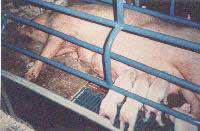
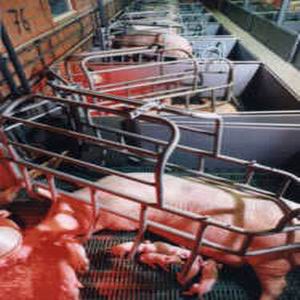
When they have young, sows are jammed between two rails, so that they cannot turn around and take care of the piglets, only feed them. This is done to prevent the sow from crushing a piglet to death, because of the lack of space.
The piglets are brought to the weaning section after the nursing period of only 3 to 4 weeks (instead of the natural 14 weeks).
At the age of about 72 days they go to the fattening farm, where 14 of them are put in a sty of 10 m2, usually on a grid floor without straw. |
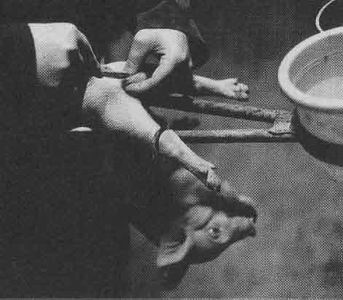
The males (boars) are castrated, in order to satisfy the foreign market, because of the alleged influence of male hormones on the scent of the meat. This actually isn't the case with pigs that are slaughtered at such a young age. The boars have to undergo castration without any anaesthesia whatsoever.
Sows suffer from severe stress (e.g. heart and stomach symptoms) because of the limitation in their freedom of movement. Out of frustration they often chew on the rails of their cage. Pigs are naturally very playful and intelligent animals.
Read more about the welfare problems of pigs on the CIWF site (Compassion in World Farming).
At the beginning of the year 2000, an investigation by the Dutch inspection service, then AID nowadays NVWA, which checks compliance with regulations showed that over 50% of the farmers violate even the minimum welfare regulations for pigs and deliberately make the animals suffer. More often than not, the pigs are kept in very tight housing, dim to dark sties, with a lack of distraction material. By keeping the animals in smaller cages, pig breeders can avoid the purchase of ammonia rights. |
Take a virtual tour of a pigsty. |
Dairy cows
Dairy cows, on average, don't live longer than four and a half years. In ideal circumstances they can reach the age of thirty, but their production level diminishes from the age of about six. During their lives they have a calf every year, because this is the only way to start the production of milk.
30% of the cows are kept in barns their entire life, to obtain a higher production level. If farmers will not be legally obliged to keep the animals in fields for a part of the year, by the year 2015 (as expected), 75% of all cows in the Netherlands will be kept indoors. |
Calves
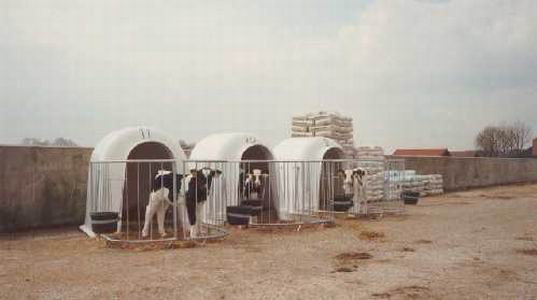
The calf is taken away immediately or after a week at the most, to prevent bonding between mother and child. They are kept in hutches.
These are the white, domed, igloo-like structures that some farmers use as outdoor "nurseries".
The hutch keeps the young calves isolated from other calves. In their first eight weeks the calves have a strong tendency to suck. When they are not allowed to suckle their mother they will suck on something else, for example, on parts of another calf's body. |
Laying hens
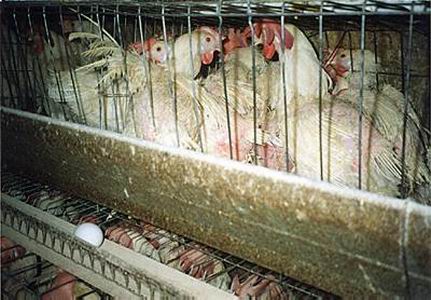
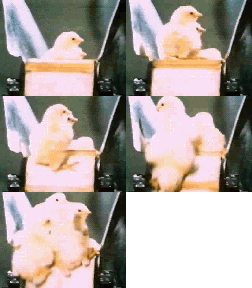 When chicks crawl out of their eggs in the hatchery, they are moved to a laying or fattening farm, depending on their race and sex. The young cockerels are 'worthless' and are killed by carbon dioxide in a plastic bag or they are shredded. When chicks crawl out of their eggs in the hatchery, they are moved to a laying or fattening farm, depending on their race and sex. The young cockerels are 'worthless' and are killed by carbon dioxide in a plastic bag or they are shredded.
|
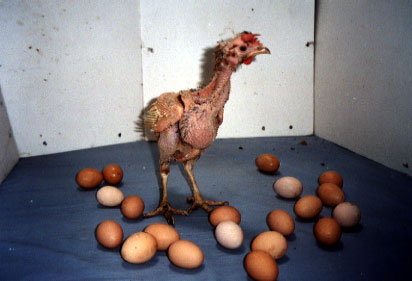
Laying hens live for about one year, when they have laid approximately 300 eggs and the only purpose left for them is to serve as chicken soup. |
Even worse are the conditions for geese and fattening ducks: force-feeding for "foie-gras" (rm-video). |
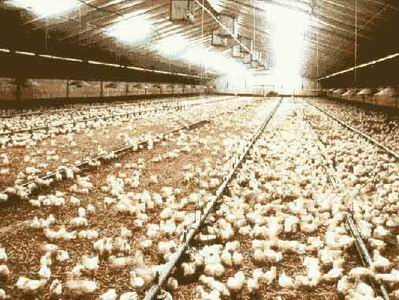
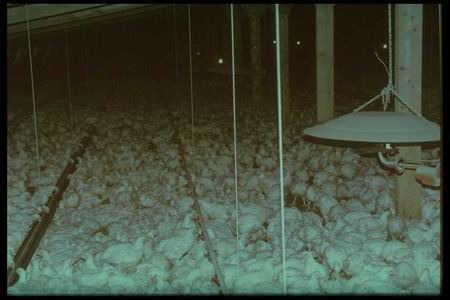
Fattening chicks
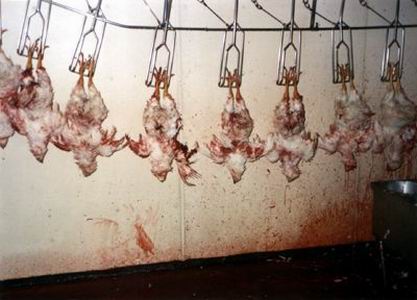
Fattening chicks live for about 6 weeks, then they are slaughtered.
In this short period of time they grow extremely fast from chick to half grown chicken on special food.
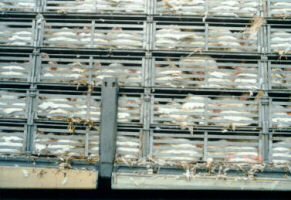
If they were to live any longer under these circumstances, they would grow far too heavy and literally end up growing to death. 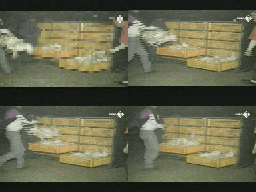 When they have to be transported to the slaughterhouse they are violently pressed in crates, often resulting in wing and foot fractures. Under these stressful circumstances they are transported on (half-open) lorries to the slaughterhouse. To prevent the chickens from getting any more fractures and bleedings, many poultry slaughterhouses use a lower electric voltage for stunning the chicks than is legally compelled. The meat of these chicks is sold as chicken meat, which stands for deception and cruelty. When they have to be transported to the slaughterhouse they are violently pressed in crates, often resulting in wing and foot fractures. Under these stressful circumstances they are transported on (half-open) lorries to the slaughterhouse. To prevent the chickens from getting any more fractures and bleedings, many poultry slaughterhouses use a lower electric voltage for stunning the chicks than is legally compelled. The meat of these chicks is sold as chicken meat, which stands for deception and cruelty. |
Turkeys
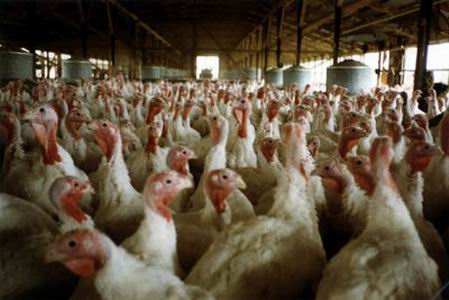
In commercial turkey farming, the animals are kept in their thousands in a small, dark space. This often leads to aggression, foot problems, stress, feather pecking and cannibalism. Because of the intensive way of farming, it is not unusual that in the first week of their lives, 40% of the turkeys die! The aim of this branch is to fatten the turkeys as quickly as possible. The breeding policy is focused on a fast growing-speed. A radical consequence of this selection is the fact that it is impossible for these animals to mate in a natural way. The cockerels are too heavily bred. The hens can only be fertilised by artificial insemination. |
Mink
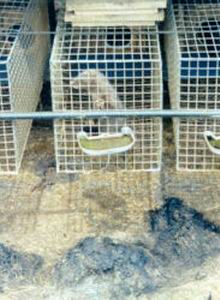
In the spring the young animals are born in cages. After seven months (when the animals have their winter fur) they are killed and skinned. During their short lives, the animals live in cages that are far too small. They cannot run, hide or escape. They have no swimming or fishing water at their disposal. They only have a drinking nipple in their cage. Mink are wild predators, and they have the same characteristics as Mink living in the wild. It's no wonder their boredom and frustration drive them crazy. This is shown in the abnormal behaviour the mink display. This behaviour consists of stereotypical behaviour - the continuous repetition of useless movements (which can also be observed in animals living in bad zoos). Apart from that, mink often bite their own tail or fur. They frequently walk in circles or constantly turn their heads around the drinking nipple. |
Rabbits
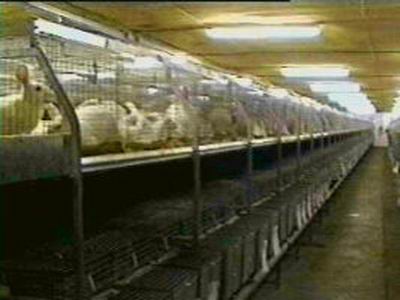
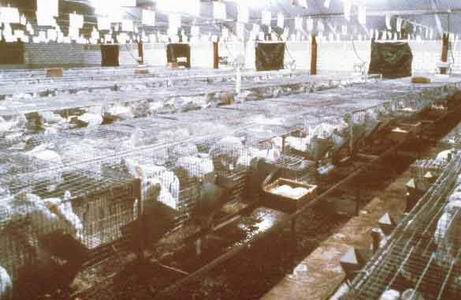 The does (female rabbits) are nothing more than disposables. When a doe can't have seven litters a year anymore, she is disposed of. The replacement percentage of does is about 90%! Besides, annually about 55% of the does are killed because of illness. This means there's a doe replacement percentage of 145%! The does (female rabbits) are nothing more than disposables. When a doe can't have seven litters a year anymore, she is disposed of. The replacement percentage of does is about 90%! Besides, annually about 55% of the does are killed because of illness. This means there's a doe replacement percentage of 145%!
There is also a high death rate among young rabbits; about 15% of the youngsters die before they're taken away from their mothers. After that, about 10% of them die. These are frightful figures, mostly caused by the terrible housing of the animals in the intensive rabbit farming (video: see video). |
International Animal Transport
Animals like sheep are transported from England to for example Greece, where they are slaughtered without anaesthesia.
Horses and donkeys from Lithuania are slaughtered in Italy. Pigs from Holland are also transported to foreign countries, f.e. to northern Italy to get slaughtered there for the sole fact that by doing so their meat returns on the Dutch market under the culinary qualification "Parma Ham".
To prevent animals from vomiting in the trucks, the animals often don't get any food the day before they're put on transportation. The animals are chased from the dark stables to the truck, in a very rough manner. Even before the journey has started, the animals are very upset. In the southern European countries, animals are frequently slaughtered without anaesthesia or with an insufficient one. But also in the slaughterhouses in Holland many chickens meet this fate. Also the ritual slaughtering is often carried out without anaesthesia, which causes the animals to suffer greatly. |
|
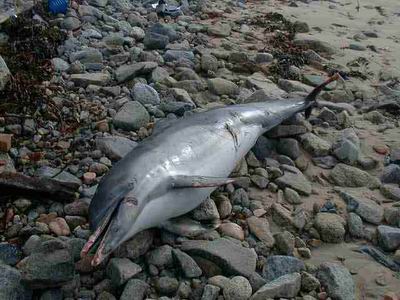 Dolphins often become tied up in the nets that have a length of some miles, and they cannot escape an agonising death by slowly drowning. Dolphins often become tied up in the nets that have a length of some miles, and they cannot escape an agonising death by slowly drowning.
When fishermen use trawl nets, not only the required fish are caught. Worse still, 70% of the catch is thrown back overboard, because the fish are too small to be legally justified for sale, or because the admitted quota has been reached, or even because the fish is not interesting, commercially speaking. The fish that are thrown overboard often are already crushed to death, have choked, or died in another way. Anyone who isn't touched by the suffering of fish during the catch, should consider the additional catch of e.g. mammals like dolphins, which are often caught at the tuna catch.
The trawl nets destroy the bottom of the sea, as a result of which the ecological system is completely out of balance, and lost for a long time. The seas are almost emptied and left completely disturbed. At this moment, the total amount of fish on earth is 50% of what it used to be a few decades ago. Fish is not only caught; it is also farmed. Some fish, like salmon, are raised in very large floating tanks; this way of breeding looks exactly like factory farming, with all its disadvantages. |
The speed and the number of animals (species) we are (ab)using is immense. For more images of the lives of these animals (and other species) before they were slain, visit the website of photographer Jo-Anne McArthur. |
|
|
|
|
| |