First of all, you are not obliged to worry about animal rights.
While freedom is important for us humans, it can be liberating to realize that animals care about freedom just as much.
It can be fun to consciously do something positive or to stop doing something harmful.
What is important though, is that we try to make it unattractive to abuse animals.
On that point, a noncommittal society is an unjust one.
Respecting animals gives better guarantee for respect towards human rights as well.
It is a daily reminder of the fact that our (eating) behaviorhas consequences for others on our planet.
These consequences stretch to other people and to animals in the rest of the world, because - part of - our food comes from that far away.
Our choices in food also affect the animals living close by, out of sight in factory farms.
You can help these animals, for instance by stop buying meat produced in factory farms, and by speaking out against factory farming as often as possible; even at the school's restaurant or at work.
Subjects
Animal rights should be legally provided for.
Collective neglect of animal rights.
Killing animals is not always necessary.
Is Industrial farming a form of pointless violence?
Animal rights are not yet provided for
It is important that animal rights are provided for
legally, which is not the case yet. As long as the animal
rights movement cannot actively and legally enforce
improvements, it is very difficult to help animals in
factory farming or to have it banned altogether. Not
enough people realize that it may be important to be
able to legally set limits to the way cattle farms are
managed. Acknowledging the intrinsic
value of animals and their right
to well-being is not enoughto get cattle farmers
to do more than just make sure their animals are fed
properly. Some things that unfortunately cattle farmers
cannot be obliged to do is make sure animals don't get
bored and that they are given the opportunity to display
their natural behavior.
Respecting animals is a voluntary
act, and it is important that people do it out
of free will. Click here to see what you can do to prevent animal suffering.
We think that animal abuse can be prevented by setting
limits for ourselves and for others in the way we treat
animals.
The collective silence surrounding the violation of animal rights
If violation of animal rights would mean "eating
meat from industrial farms or keeping animals in small
cages", then the percentage of people not really
considerate of animals may be as high as 95%. This high
percentage coincides with the observation that so few
people are dedicated to the well-being of animals in
industrial farming. Most people think they might lose
something by taking animal rights seriously: it will
cost them more money and effort and they will have to
admit that they have not been doing the right thing
before. This is not easy and attractive.
Unlike in the struggle for equal rights between black
and white and between men and women, animals cannot
directly call man to account on the injustice done to
them. Like the emancipation of man, the emancipation
of animals is a development that needs to take place
inside people's minds. Man must
free himself from the arrogance that he is
better than an animal, that animal interests do not
matter and that he does not have to concern himself
with them.
Responsible eating and buying habits do not have to
have financial consequences, because what we need to
achieve is a decrease in meat consumption and fairer
prices for ecological meat for people who do still want
to eat meat. The opposite effects will balance each other.
Situations in which man kills animals
Most of these actions concern animals that are bred
specially for people. It is possible to omit most of
these actions by finding substitutes for animals or
by keeping animals away from that which needs to be protected.
For what reason or in what situation?
Reason for killing animals
food
slaughter, protection of crops
fashion
trapping game, fur trade and byproducts
of food
housing
clearing habitats for construction
work and maintenance
medicines and cosmetics
laboratory animals
hunting
shooting and fishing
traffic
road kill, road construction
pets
neglect, birth control
zoo's
birth control
Can industrial farming be considered as a form of senseless violence?
Not many of us will use senseless violence against
people, but how about animals? Can we consider the boredom
of animals in industrial farming meaningful? Is our
need to consume meat sufficient justification to deny
these animals a natural and free life?
Can we honestly say that we do not participate in this?
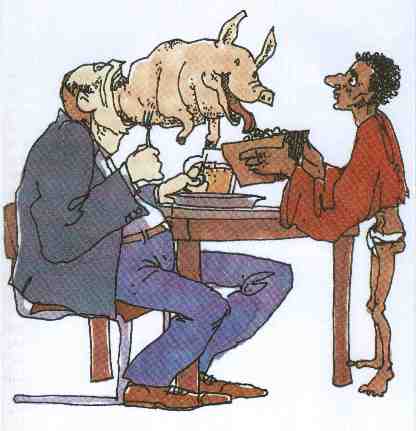
If you eat meat from industrial farms, you are passively
contributing to passive and senseless violence.
If you go on holiday to Spain and watch the bullfights
or go to a fiesta, you are contributing a bit less passively
to active violence.