How the dog became a companion animal
The ancestor of the dog: the wolf
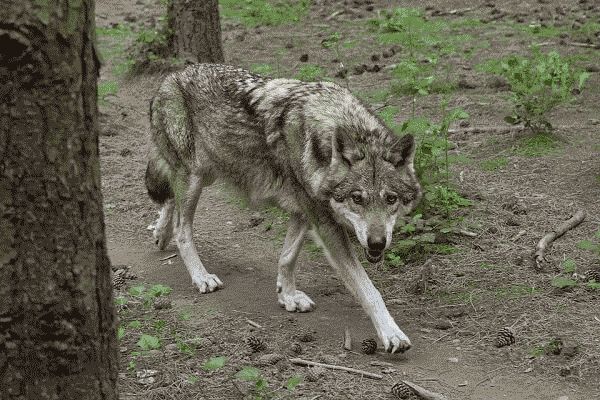
The dog descends from the wolf. According to DNA research, this is not the gray wolf of today. The ancestor is an extinct group of wolves that was closely related to the gray wolf. Dogs are most similar to ancient wolves from Asia. In dogs from the Middle East and Africa, up to half of the DNA comes from wolves from southwest Eurasia.
Scientists believe that domestication began when certain wolves were less shy. They settled near humans, attracted by food scraps. These wolves had an advantage: they were tamer and could cope better with the presence of humans.
Since when have dogs lived with humans?
The oldest certain find of a dog that lived with humans is more than 14,000 years old. It is a grave in Bonn-Oberkassel (Germany). It held a young dog that had been ill and had been cared for by people. According to DNA research, the split between wolf and dog began earlier, somewhere between 20,000 and 40,000 years ago. Older finds from Siberia and Belgium are disputed: they may also be wolves. About 11,000 years ago there were already at least five different dog lineages.
Domestication may have happened in more than one place. It is also possible that early dogs later mixed with wolves from another region. It is not certain whether humans came to the wolf or the other way around. The most accepted theory is that it was a gradual process of mutual adaptation.
Both benefited from the situation. Humans used the dog for hunting. Its sharp senses and speed were indispensable for tracking and chasing game. The dog was also used for herding livestock, for guarding property and for warning against enemies or predators. In Siberia, dogs were already pulling sleds 9,500 years ago. Humans, in turn, made sure that the dog had food, protection from other predators and a safe place to rest.
Why the dog understands humans
The wolf is a very social animal. Like humans, it lives in a group: the pack. A pack is usually a family, with two parents and their young. The parents lead the way. The image of a strict hierarchy with an 'alpha wolf' at the top comes from research on wolves in captivity. In wild wolves it is not correct. This life in a group made it easier for humans and dogs to live together.
Dogs pay close attention to human gestures and looks. For example, they follow a pointing hand to hidden food. Wolves can learn this too, but mainly when they grow up with people from a young age. This makes the dog suitable and attractive as a companion animal.
The first breeds
People began to make different demands on the behavior and appearance of the dog. Selective breeding reinforced certain traits: some dogs became smaller and more playful, others larger and more protective. All over the world, dogs emerged for hunting, for herding livestock and for guarding. Notably, the body also changed during domestication. Dogs got floppy ears, curled tails and spotted coats. These traits are rare in wild wolves.
The dog as a status symbol
During the Middle Ages, people began to regard the dog as a kind of status symbol. Noble families kept certain breeds for hunting and for display. Owning such a dog showed your social position. Small lap dogs became popular among the European nobility. Large hunting dogs such as greyhounds were reserved for the elite. The dog gave people prestige. It was even depicted in family portraits and coats of arms.
From a few dozen to hundreds of breeds
Around 1800 there were a few dozen types of dogs. Official breeds did not exist yet. They only came in the nineteenth century, with the first dog shows (Newcastle, 1859) and the first breed club, the English Kennel Club (1873). Today the Fédération Cynologique Internationale (FCI) recognizes more than 360 breeds. If you include the breeds that are only recognized nationally or not at all, you get more than 400.
Dogs were bred for size, length, color, head shape, behavior and cuddliness. From the tiny Chihuahua of 1.5 kilograms to the Saint Bernard of sometimes 90 kilograms: the diversity within a single species is extraordinary. Most of it arose only in the last two centuries. This makes the dog a striking example of human-guided evolution.
This still continues. Often appearance and breed traits weigh more heavily than the health of the dog. You can read what that means in the consequences of irresponsible breeding for dogs. First we look at modern day dogs.
Sources: Bergström et al., Nature 2022 (ancestry); Bergström et al., Science 2020 (dog lineages); Botigué et al., Nature Communications 2017 (20,000 to 40,000 years); Janssens et al., 2018 (Bonn-Oberkassel); Sinding et al., Science 2020 (sled dogs); Mech, 1999 (pack); Hare et al., 2002 and Udell et al., 2008 (gestures); The Kennel Club; FCI. Updated on 16 October 2026.
Read also: The slaughter of dogs and cats for food. In parts of Asia the dog is still not a companion animal but meat. |